
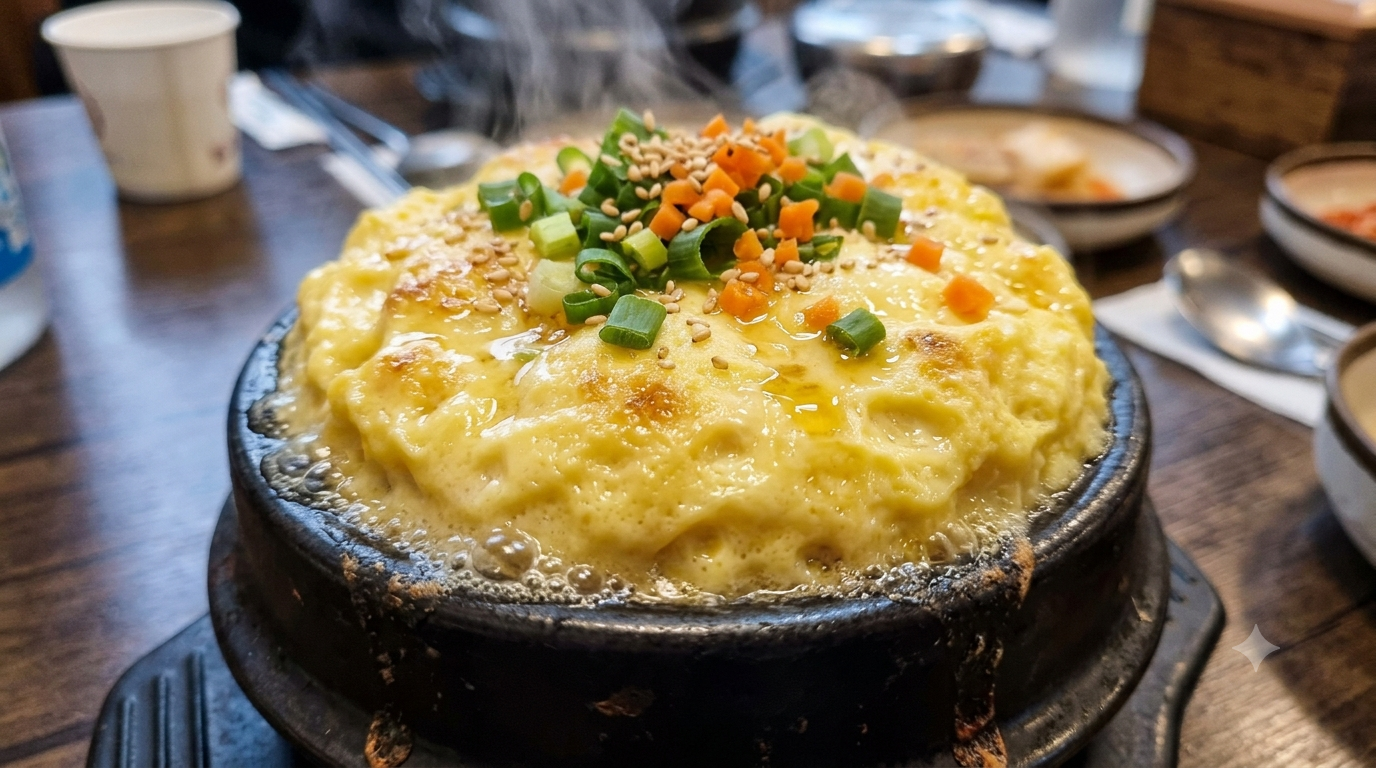
Gyeran-jjim: Fluffy and Savory Korean Volcano Steamed Eggs 🌋🥚
Soft enough to scoop with a spoon, savory enough to steal the spotlight, and dramatically puffed like a tiny volcano—gyeran-jjim is one of Korea’s most comforting egg dishes. This Korean steamed egg recipe turns a few everyday ingredients into a cloud-like side dish with a gently custardy center, ideal alongside rice, grilled meat, kimchi, or a warming bowl of soup.
Often served in a sizzling earthenware pot called a ttukbaegi, volcano gyeran-jjim rises high above the rim as steam expands through the whisked egg mixture. It is quick, affordable, family-friendly, and wonderfully adaptable—exactly the kind of Korean comfort food worth mastering at home.
📜 The History of Korean Steamed Eggs
Gyeran-jjim (계란찜) literally means “steamed eggs” in Korean. It has long been a familiar banchan, or Korean side dish, appearing on home tables and in Korean barbecue restaurants throughout South Korea. While eggs were once considered a valued ingredient in Korean households, the dish became especially popular because it could stretch a small number of eggs into a nourishing shared side.
Traditional versions are made by slowly steaming beaten eggs with water or anchovy-kelp broth. Modern restaurant-style gyeran-jjim often uses a stovetop method in a ttukbaegi, producing the beloved fluffy “volcano” dome. The dish is especially popular in Seoul barbecue restaurants, where its mild, silky flavor balances spicy pork belly, smoky bulgogi, and fermented kimchi.
🛒 Ingredients for Fluffy Gyeran-jjim
- 4 large eggs
- 1 cup warm anchovy-kelp broth, chicken broth, or water
- 1/2 teaspoon salt, or to taste
- 1 teaspoon fish sauce or Korean soup soy sauce (optional, but deeply savory)
- 2 tablespoons finely chopped scallions
- 1 tablespoon finely diced carrot or zucchini (optional)
- 1 teaspoon toasted sesame oil
- 1 teaspoon toasted sesame seeds for garnish
Best vessel: A small Korean earthenware bowl or 5- to 6-inch saucepan with a lid. A deep bowl helps create the classic puffed volcano shape.
🍳 How to Make Korean Volcano Steamed Eggs
- Whisk the eggs smoothly 🥚
Crack the eggs into a medium bowl. Add salt and fish sauce, then whisk until the yolks and whites are fully combined. For an exceptionally silky texture, strain the mixture through a fine-mesh sieve. - Add warm broth 💧
Slowly whisk in the warm broth or water. A ratio of about one part egg to one part liquid creates a tender, spoonable custard. Stir in most of the scallions and any diced vegetables, reserving a little scallion for the top. - Start over gentle heat 🔥
Lightly grease your ttukbaegi or small saucepan with a few drops of sesame oil. Pour in the egg mixture and place the pot over low heat. Stir gently for the first 2 to 3 minutes, scraping the bottom to prevent curds from setting too quickly. - Cover and steam until puffed 🌋
Once small curds begin to form around the edges, stop stirring. Cover with a lid and cook on the lowest heat for 6 to 8 minutes. The eggs should slowly rise into a soft dome. Avoid lifting the lid repeatedly, as trapped steam creates the signature lift. - Finish with aroma and color ✨
Turn off the heat when the center is just set but still jiggles slightly. Let it rest, covered, for 1 minute. Drizzle with sesame oil and scatter over sesame seeds and reserved scallions. - Serve immediately 🍚
Bring the pot to the table while it is still puffed and steaming. Serve with hot rice, kimchi, grilled short ribs, or spicy Korean tofu stew.
🌿 Health Benefits and Smart Cooking Tips
Eggs provide high-quality protein, vitamin B12, choline, and selenium. Because gyeran-jjim is steamed rather than fried, it needs very little oil. Adding scallions, carrots, zucchini, or finely chopped mushrooms brings extra color, fiber, and micronutrients without overpowering the delicate egg flavor.
- Keep the heat low: High heat creates holes, rubbery curds, and a scorched base.
- Use broth for depth: Korean anchovy-kelp stock gives the most traditional savory flavor.
- Do not overcook: Remove the pot when the center still trembles slightly; residual heat will finish it.
- For a taller dome: Use a narrower, deeper pot and keep the lid closed during cooking.
- For children: Skip fish sauce and use mild chicken broth or water with a pinch of salt.
❓ Gyeran-jjim FAQ
What makes gyeran-jjim rise like a volcano?
The dramatic rise comes from steam trapped in the covered pot. Low, steady heat cooks the egg gradually while steam expands throughout the mixture. A deep ttukbaegi or small saucepan helps support the tall, fluffy dome.
Can I make Korean steamed eggs without a ttukbaegi?
Yes. Use a small heavy-bottomed saucepan with a tight-fitting lid, a heatproof bowl set in a steamer, or an oven-safe ramekin in a water bath. A ttukbaegi is traditional, but it is not required for creamy results.
Can I make gyeran-jjim ahead of time?
Gyeran-jjim tastes best freshly cooked, when it is light and puffed. You can whisk the eggs and vegetables up to one day ahead and refrigerate them, but cook the dish just before serving. Reheated steamed eggs are safe but less airy.
What can I substitute for anchovy-kelp broth?
Use low-sodium chicken broth, vegetable broth, dashi, or plain water. If using water, add a small amount of fish sauce, soup soy sauce, or a pinch of salt to maintain the savory Korean-style flavor.
Why did my steamed eggs become watery or rubbery?
Watery gyeran-jjim usually needs a little longer cooking time, while rubbery eggs are often caused by excessive heat or overcooking. Cook slowly over low heat and remove the pot as soon as the center is softly set.
🥬 Recommended Ingredients
Bring authentic Korean comfort-food flavor to your kitchen with flavorful anchovy-kelp stock, Korean soup soy sauce, and toasted sesame oil.
🍲 Recommended Kitchen Tools
A traditional Korean ttukbaegi helps create the beautifully puffed, restaurant-style volcano effect while keeping your steamed eggs warm at the table.
👉 Check Out Essential Cooking Tools on Amazon
* Disclaimer: As an Amazon Associate, I earn from qualifying purchases at no additional cost to you.
TAGS: #GyeranJjim, #KoreanFood, #SteamedEggs, #KoreanRecipes, #ComfortFood
Leave a Reply